Francis Gumerlock

Books and Articles on the Theology of Grace and Eschatology
  • .: Welcome :.

    Welcome to the website of Francis X. "Frank" Gumerlock, Ph.D. If you have an interest in the theology of grace or eschatology (the study of end times) from a historical perspective, I invite you to browse this site.
  • Hippolytus of Rome’s Commentary on Daniel

    Posted By Frank on November 7, 2009

    Hippolytus was a presbyter in the church at Rome about 200 AD. It is he who started the genre of literature we know as biblical commentaries, being the first to write a running commentary on one book of the Bible. The book he chose was the prophet Daniel. Hippolytus’ church was suffering under the persecution of the emperor Septimus Severus, and as a pastor he used the examples of Daniel, Susanna, and the three youths to encourage his congregation to endure the persecution.

    There is a new book out by W. Brian Shelton entitled Martyrdom from Exegesis in Hippolytus: An Early Church Presbyter’s Commentary on Daniel. It’s put out by Paternoster Press in their series “Studies in Christian History and Thought.” Since Hippolytus’ commentary is still in Greek and unavailable in English translation, Shelton’s book is the best means of ascertaining the contents of the commentary (unless you read patristic Greek).

    I recommend the book for those interested in the subject of persecution and martyrdom in early Christianity, early Christian eschatology, patristic biblical commentaries, or the book of Daniel. It contains some interesting information. For example, Hippolytus’ Daniel commentary tells about a Christian leader in his day who prophesied that the Lord was coming soon, and consequently led his congregation out to the desert to wait for Jesus. People quit their jobs and went along. But when the leader’s prophecy did not come true, they were all humiliated, and returned to their former lives. Hippolytus says that Christians in persecution cannot always expect the Lord to intervene by His coming; it is God’s will for some to endure martyrdom.

    Martyrdom from Exegesis is available for purchase from the publisher and Amazon.com.
    For a full review of Martyrdom from Exegesis in Hippolytus, refer to the Book Review page.

    • Share/Bookmark

    Predestination in the Century Before Gottschalk

    Posted By Frank on October 13, 2009

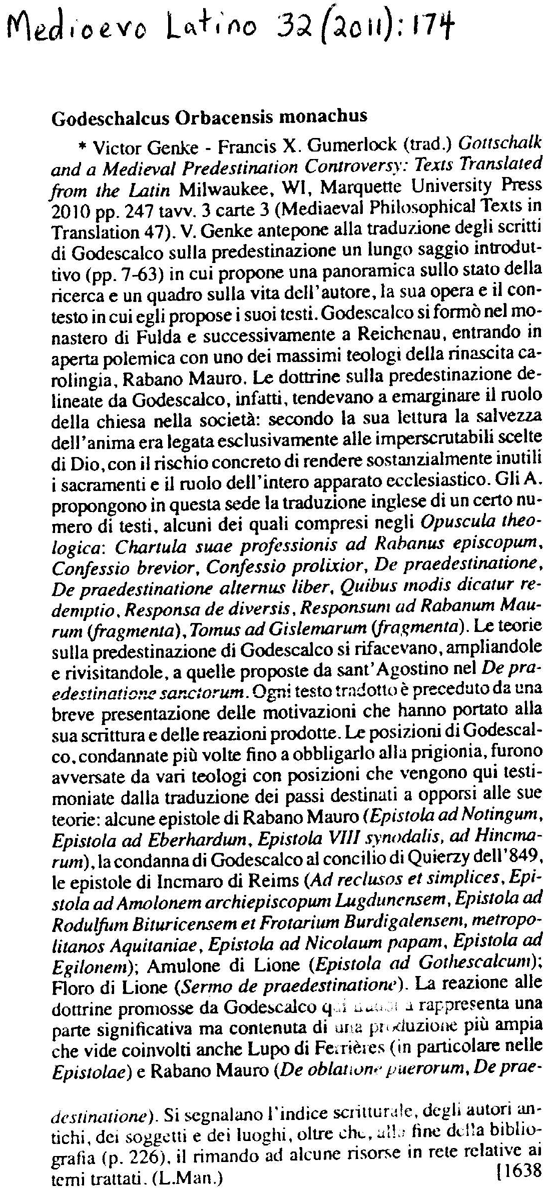
    In the mid-ninth century, a wandering monk named Gottschalk of Orbais (d. 868) sparked a controversy over divine predestination that shook both church and state in central Europe. But was Gottschalk the maverick that he is often made out to be? What did the church teach about grace and divine predestination in the century before Gottschalk? Through examination of the theological literature written between 740 and 840 AD, this two-part series answers those questions.

    These articles appeared in recent issues of Evangelical Quarterly. You can read both articles here: Predestination in the Century Before Gottschalk, Part 1 & Part 2

    Have a great day. Frank

    • Share/Bookmark

    Fulgentius of Ruspe on the Saving Will of God

    Posted By Frank on August 24, 2009

    Fulgentius was born in the year 468 and educated in Vandal North Africa. After a short career in finance he joined a monastery. He later was elevated to an abbot and in the year 508 became bishop of Ruspe, a coastal town in modern Tunisia.

    Fulgentius defended the doctrine of the Trinity against Arianism, which was the official religion of the Vandals that denied that the Son was one in being with the Father. He was exiled for his Trinitarian faith to the island of Sardinia for fifteen years. Fulgentius also wrote treatises on grace, free will, and divine predestination. These works are largely the foci of my book entitled Fulgentius of Ruspe on the Saving Will of God: The Development of a Sixth-Century North African Bishop’s Interpretation of 1 Timothy 2:4 During the Semi-Pelagian Controversy (Mellen, 2009). It shows that in his earlier writings, Fulgentius often asserted the universality of God’s saving will and general grace. But as he entered a debate on grace and free willl, he restricted that universality to all those among the nations predestined by God for salvation.

    There are only two other books in print in English devoted to Fulgentius, and Fulgentius on the Saving Will of God is the only one devoted wholly to his theology of grace. It is based upon the latest scholarship on Fulgentius, and in it many passages from his works are translated for the first time in English. In addition, other texts from his time period are translated therein, such as Caesarius of Arles’ On Grace and short works by John Maxentius. Available only in hardback and published by an academic press, Fulgentius on the Saving Will of God is expensive, but worth the investment for those interested in the theology of grace in church history, Augustinian studies, and the Semi-Pelagian debate. To read a review of it, click here. To order a copy, click here. Happy reading. Frank

    • Share/Bookmark